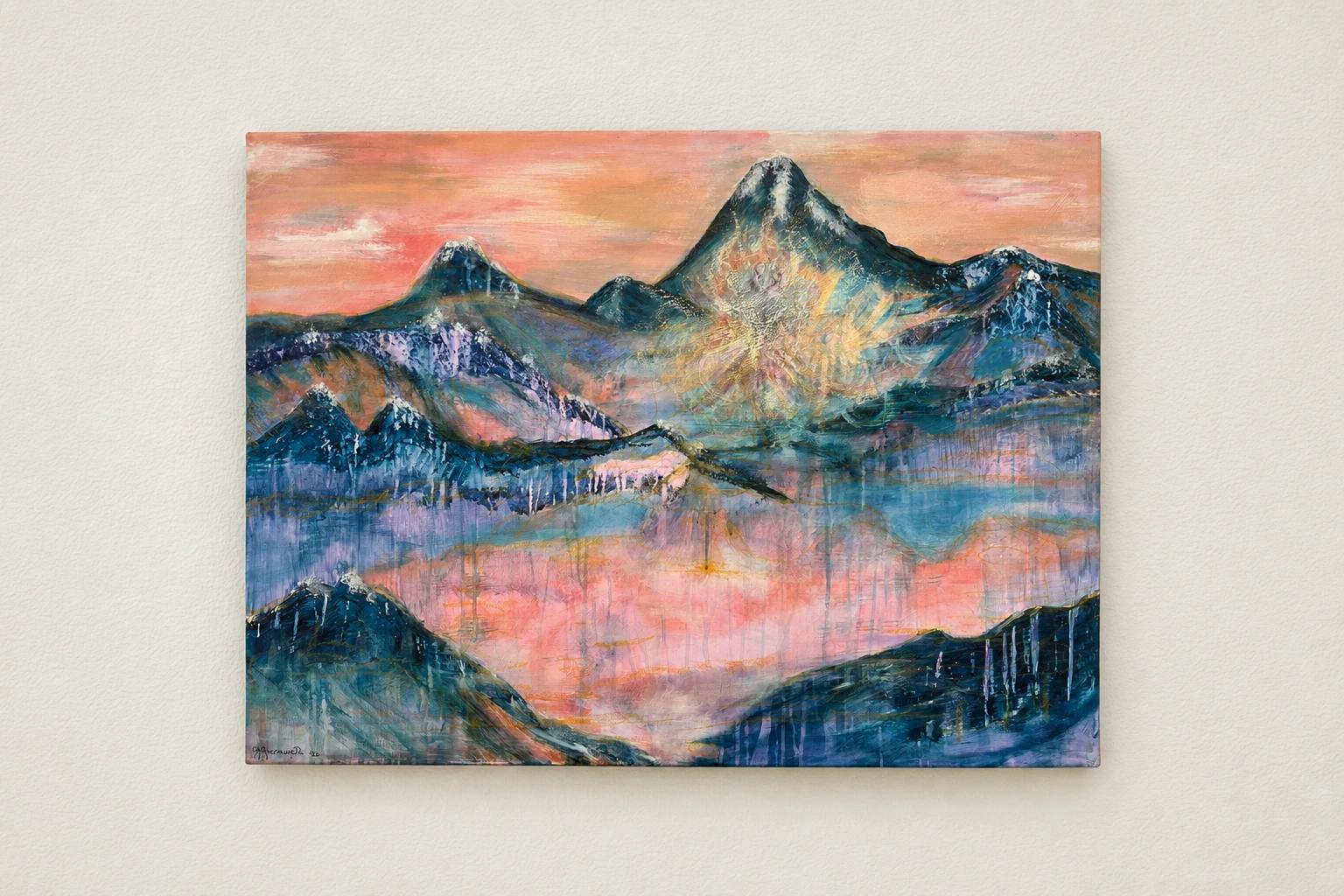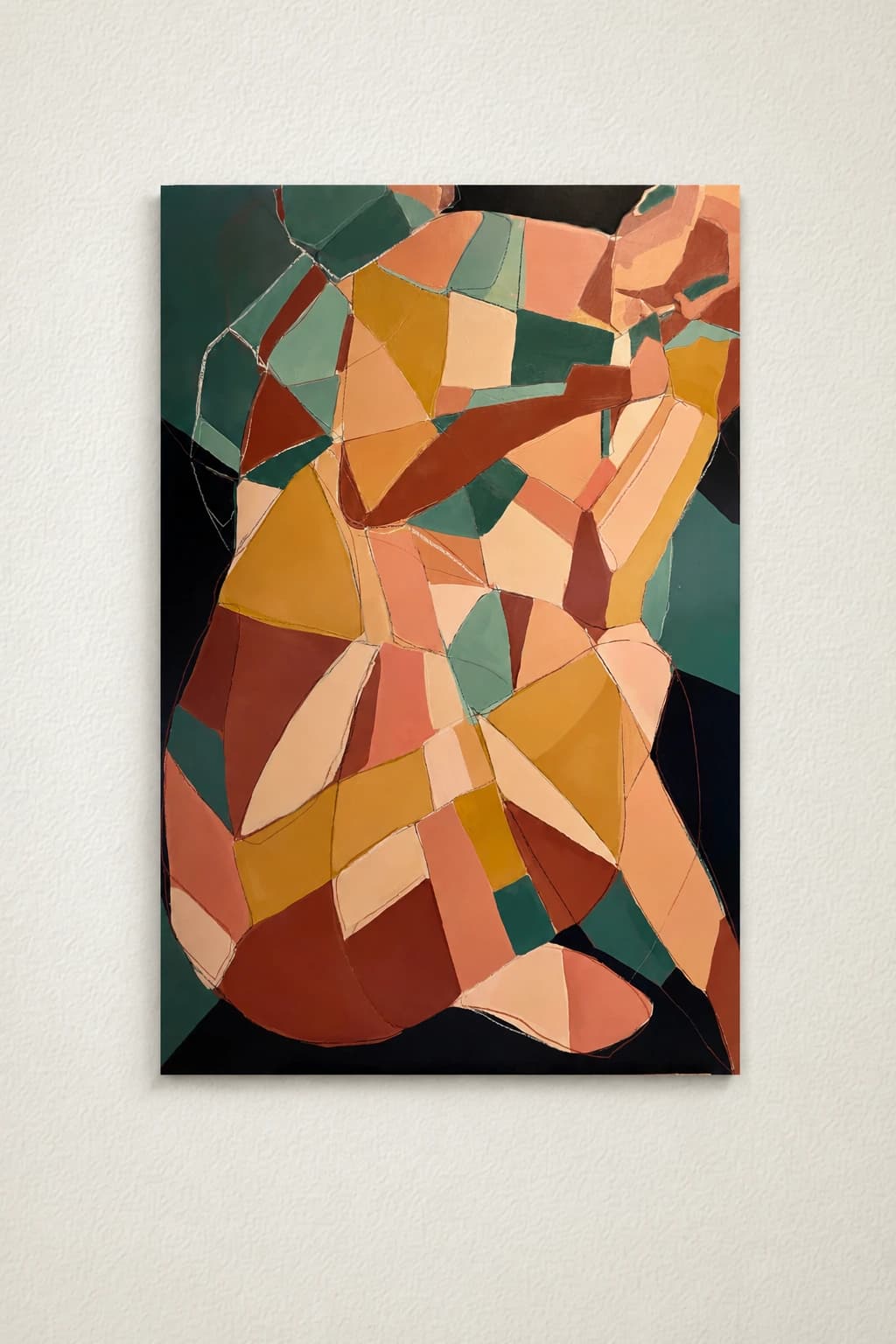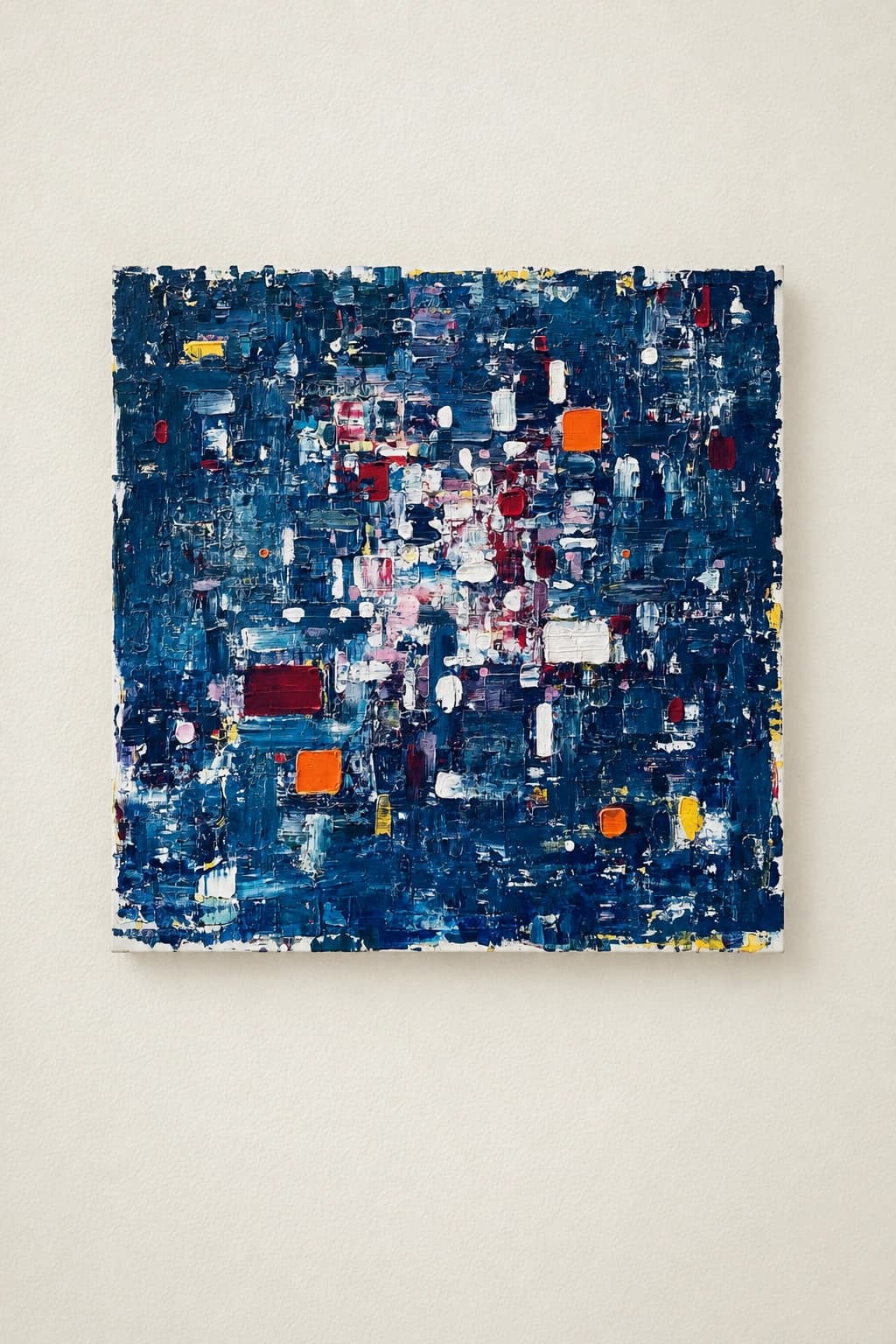


This guide covers the common rules of thumb, then goes room by room: sofa, bed, dining table, hallway, staircase and small walls. For very large pieces and XXL canvases, our guide to large wall art goes further.
The rules of thumb, with real numbers
Width first. When a painting hangs above a piece of furniture, aim for about two-thirds of the furniture's width. Design guides vary a little: some accept up to three-quarters, and most agree that anything under half looks lost. Treat it as a starting point, not a law.
Height second. Place the centre of the work about 145 to 152 cm (57 to 60 in) from the floor. That band matches the eye level of a standing adult, and many galleries hang to it so that every work in a room lines up on the same midline. In a room where people mostly sit, you can come down a few centimetres.
Third, the gap above furniture. Leave roughly 15 to 25 cm (6 to 10 in) between the top of the sofa back, headboard or sideboard and the bottom of the frame. When furniture is involved, this gap usually wins over the centre-height rule: the painting should read as one unit with the piece below it.
Above a sofa or a bed
A common three-seat sofa is about 200 to 215 cm (79 to 84 in) wide. Two-thirds of that gives a painting, or a group of paintings, about 130 to 140 cm (51 to 56 in) wide. If you find a piece you love at 100 cm, it can still work: pair it with a lamp or a plant so the wall does not look half empty, or hang two works side by side with a 5 to 8 cm gap between them.
Above a bed, use the headboard or the mattress width. A queen bed is 152 cm (60 in) wide, so look for about 100 cm (40 in) of art. A king is 193 cm (76 in), so about 125 to 130 cm (50 in). Keep the bottom of the frame 15 to 25 cm above the headboard. Over a bed, choose a light frame and solid hardware, since someone sleeps under it.
Dining room, hallway and staircase
In a dining room, people look at the wall while seated, so hang a little lower than usual. Above a sideboard 180 cm wide, a work of about 120 cm fits the two-thirds rule. On a bare wall beside the table, size the art to the table instead: for a 180 cm table, something between 90 and 120 cm wide keeps the wall in proportion.
A hallway is often about 1 m wide, so you see the art from very close. Smaller works, around 30 to 60 cm, read better there than one big canvas you can never step back from. A row of two or three small pieces at the same centre height works well along a long corridor. Avoid deep frames that people will brush against.
On a staircase, keep each work about 145 to 152 cm above the step directly below its centre, not above the floor at the bottom of the stairs. The group then climbs at the same angle as the handrail. Stairs are a good place for a gallery wall, as long as the whole arrangement follows that diagonal.
Small walls and gallery walls
On a narrow wall with no furniture, such as the 80 cm between a door and a window, size the art to the wall. Leave at least 15 to 20 cm of bare wall on each side. One small original in the 40 to 50 cm range often looks more deliberate than a large piece squeezed in.
A gallery wall is several works treated as one block. Measure the outer edges of the whole group and apply the same rules: about two-thirds of the furniture width, and the centre of the block at 145 to 152 cm. Keep the gaps between frames even, around 5 to 8 cm (2 to 3 in). Start with the largest piece near the middle and build outward.
Test it with paper and painter's tape first
Before you buy, cut a sheet of kraft paper or taped-together newspaper to the exact size of the painting you are considering, frame included. Stick it to the wall with painter's tape at the height you plan. For a gallery wall, cut one template per work and move them around until the gaps look even.
Leave the templates up for a day or two and look at them from the doorway, from the sofa and at night. If the paper feels too small, it is. Then mark the hook position on the template itself (measure from the top of the work to the taut wire or the D-rings) and drill through the paper. For anything heavy, use two hooks rated for the weight.
Where L'Original fits
L'Original is a non-profit gallery founded in Montréal in 2017, with more than 850 living artists. Every work in the catalogue is a signed original with its exact dimensions listed, from small pieces for a hallway to large canvases for a sofa wall, starting around CA$125. If no size fits your template, you can commission a piece to the exact dimension, which takes 2 to 6 weeks. You can also see works in person at our two galleries in Old Montréal and on the Plateau, open every day from 11 a.m. to 6 p.m.