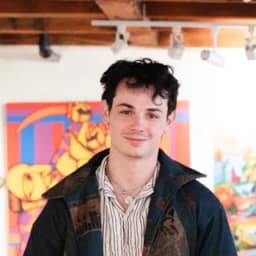
Korb: graffiti, science fiction and the machinery behind the image
Published July 30, 2026
Korb belongs to the generation of Montréal writers who never had to choose between the wall and the canvas. Fifteen years of lettering, a crew, a comic-book culture and a taste for science fiction produced a body of work that reads on two levels: a surface that seduces, and a structure that questions.
This monograph retraces his practice, from the Crazy Apes walls to the canvases held in our Montréal galleries, and situates it in the local graffiti lineage documented by Art Crimes, Bombing Science and Wall2Wall Montréal.
A writer's training, not a school's
Korb learned in the way most Montréal writers of his generation learned, on walls rather than in studios. Fifteen years of practice mean fifteen years of letters: the discipline of proportion, of a line that must hold at four metres, of a composition decided before the first can is shaken. That apprenticeship leaves a mark that no art school reproduces, a sense of scale and of speed that stays in the work even once it moves onto stretched canvas.
His references say a great deal about the visual culture he comes from. Science fiction, cinema and Japanese manga are the three sources he names, and all three share a common trait: they build worlds rather than depict them. Bombing Science, the Montréal graffiti supplier that has documented local writers on video for two decades, and Art Crimes, the oldest graffiti archive online, both hold pages under his name, which is the ordinary form of recognition in this discipline.
« Freeing humans from the matrix is my goal. »
The grid as a subject
What distinguishes Korb from a pure stylist is that his work has an argument. In his own statement of intent, he examines the effect of the many grids of our environment on human beings and on our capacity to adapt to a world in constant change. The word matters: a grid is what lies underneath, the structure you stop noticing because it is everywhere. Painting it means making visible the framework that organises perception.
From that premise comes a surrealist vocabulary in which figures, mechanical elements and letter fragments coexist without ever settling into a single reading. The eye first takes in an overall motif, then discovers a second level. It is exactly the double reading that graffiti has practised for forty years, where the uninitiated see decoration and the initiated read a name, transposed here into a language accessible to anyone.
The walls: Crazy Apes, Under Pressure, Bistro Ste-Cath
Korb paints within the Crazy Apes, one of the crews that structure the Montréal scene. A crew is not a label, it is a working unit: shared walls, a division of labour between letters and characters, a collective signature. Wall2Wall Montréal, which has documented the city's graffiti since 2015, records his contributions to the crew's walls, including at Under Pressure, the oldest graffiti festival in North America, where he handled letters on the K6 and Crazy Apes wall and painted the crew's character.
Among his collaborations, the samurai mural painted with Monk.E and Axe at Bistro Ste-Cath deserves attention, because it shows how the Montréal scene actually works. Three artists with different practices, a neighbourhood venue rather than an institution, a wall that becomes a landmark. This is how a city builds a mural culture, one commercial facade at a time, long before festivals and public art programmes arrive.
From spray can to gallery wall
The passage from wall to canvas is where many writers lose what made them good. The street rewards impact and legibility at distance; the gallery rewards density and duration. Korb solved this by keeping the graphic economy of graffiti and slowing everything else down. His canvases hold the eye longer than a wall does, because they are built to be looked at from a metre away for several minutes rather than from a car.
His practice also extends into comics and sculptural installation, which is consistent rather than scattered: all three media let him build a world and then place a viewer inside it. In November 2022, the regional weekly L'Express covered one of his exhibitions, a reminder that the audience for this work is not confined to the graffiti milieu.
Where Korb sits in the Montréal scene
Montréal graffiti has a documented lineage. Zilon opened the way in the late 1970s, the 1990s produced the crews and the writers who still hold the walls today, and the 2010s brought festivals, permits and public commissions. Korb belongs to the segment that has stayed on both sides of that history: still painting crew walls, while producing studio work that a collector can live with.
That position is what makes his work valuable to a collection. A canvas by an artist who no longer paints walls is a souvenir of a practice; a canvas by an artist still active on the street is a fragment of a living body of work whose public side can be seen a few streets away.
Collecting a work by Korb
L'Original represents Korb and holds his canvases in its two Montréal galleries. Each work is original, signed and accompanied by a certificate of authenticity, with dimensions and price shown on its page. Formats vary enough that the same artist can answer a small interior wall or a large corporate one, which matters when a piece has to hold a room rather than decorate it.
For a wall rather than a canvas, the same artist can be commissioned. A mural is quoted on surface, access, support and time on site, and our team scopes the project before any figure is advanced.