en

Month 09

Art Gallery Contract, Fairs and B2B Sales

Understand the gallery market, pick the right art fairs, and learn B2B sales to companies.

Questions in this month (9)

  • How to get my artworks into a gallery in 2026

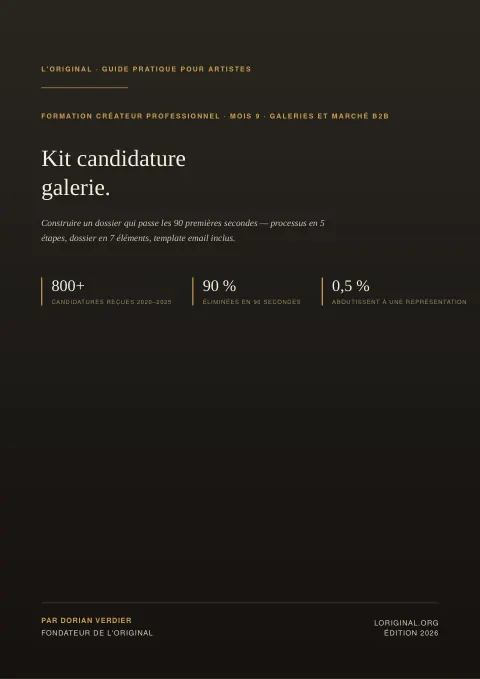
    Getting your artworks into a recognized gallery requires 5 steps: identify the 5-10 galleries that truly match your positioning (not all of them), build a complete artist portfolio (CV, statement, 15-20 high-res artworks, studio video), approach with a personalized email (no mass mailing), propose a short meeting (15-20 mins max), and negotiate standard terms (40-50% commission, 6-12 months duration, geographic exclusivity). Typical response rate on a well-prepared portfolio: 15-25%. Out of 8 galleries approached, 1-2 positive responses.

    8 min read
  • Renting artworks: economic model in 2026

    Emerging artists in Quebec rarely use artwork rental as a business model. Three main channels: Canada Council Art Bank (institutional rental, rent $60-3,600/year per artwork), direct rental to businesses (typical rent 5-15% of the sale price per year), and municipal programs. 80% of rentals end in purchase within 2-5 years. It brings steady recurring income while you keep ownership of the work, which suits emerging artists who want predictable income.

    8 min read
  • Choosing my art fair: 5 criteria to decide in 2026

    Which art fair you pick has a big effect on your profit for the year. 5 criteria to decide: buyer profile matching vs your rate (premium fair for works above $3,000, emerging fair for $500-3,000), booth cost vs budget (typically $800-3,500 in Montreal), fair sales history (ask previous exhibitors), organizational support (structured vs self-organized fair), geography and logistics. Main Quebec fairs in 2026: Papier (April, works on paper), Plural (spring, accessible contemporary art). Internationally: Art Toronto (October), Art Basel Miami (December, very selective access).

    8 min read
  • Choosing a gallery: 7 criteria before signing in 2026

    Choosing a gallery before signing requires evaluating 7 criteria: the gallery's reputation and history (minimum 3-5 years of existence), already represented artists and their trajectory, commission and financial terms (40-50% standard), frequency and quality of exhibitions, presence at fairs and events, the gallery's marketing and communication, and human compatibility with the gallerist. The worst choice: accepting the first gallery that says yes without checking. A bad gallery can stall your career for 3-5 years while you get out of the contract.

    8 min read
  • Standard gallery contracts: 8 clauses to negotiate in 2026

    A gallery representation contract should never be signed without negotiation. 8 clauses to watch: commission (40-50% standard, negotiable based on status), geographic exclusivity (limited to city or province, never worldwide), duration (12-24 months renewable rather than 5+ years), number of artworks in simultaneous consignment, payment terms (30 days post-sale ideal), insurance of consigned artworks, exit conditions (60-90 days notice), and derivative rights (the gallery does not acquire copyright). The RAAV standard contract is a good baseline.

    9 min read
  • Galleries that buy artworks: direct sale vs consignment model in 2026

    The majority of galleries operate on consignment (the gallery exhibits but does not buy, pays after an actual sale). But a few galleries buy their artworks directly, particularly for established artists or major pieces. Advantages for the artist: immediate income, without waiting for a sale. Disadvantages: reduced purchase price (typically 30-50% of public sale price) because the gallery assumes the sales risk. Models to know in 2026: partial direct purchase, classic consignment, firm buyout of a complete series, lease-to-own (Art Bank). Choose according to your immediate need for liquidity vs your ability to wait.

    8 min read
  • Placing my artworks in cafes: complete method for 2026

    Placing artworks in cafes and commercial venues is a supplementary channel for emerging artists. Advantages: visibility with varied audiences, occasional sales, network building. Disadvantages: low institutional prestige (doesn't count as an 'exhibition' on a CV), limited sales in volume and average price, risk of artwork degradation. Typical cafe commission: 20-30% (vs 40-50% in gallery). Ideal for: artists starting out, moving unsold inventory, local presence in one's neighborhood. Not to be considered a long-term career strategy.

    7 min read
  • Contacting a company to pitch my artworks: 2026 B2B guide

    To sell your works or murals to a company, you first need to find the right decision-maker. 4 profiles to know, by company size: SME (CEO or general manager, sole decision-maker), large company (space manager or facility manager), corporate culture / HR (art-wellness programs), general services / acquisitions (major purchases). Approach: LinkedIn for identification, personalized email for first contact, in-person meeting for qualification, structured quote for conversion. Typical conversion rate of well-done B2B prospecting: 2-5% from first contact to sale. Out of 60 emails, 1-3 sales.

    8 min read
  • Artist corporate deck: structure and examples 2026

    A good corporate deck helps turn a B2B meeting into a sale. Recommended structure in 12-15 slides: cover, who I am (2 slides), my statement in 1 slide, examples of past B2B projects (4-5 slides), working process, indicative pricing, client testimonials, offered services, and call to action. 16:9 landscape format, simple professional design, max 30 words per slide, high-res photos taking up most of the space. Oral presentation: 12-20 minutes maximum + 10-15 minutes of questions. A good deck converts 30-40% of meetings into projects.

    8 min read

Free tools from this module