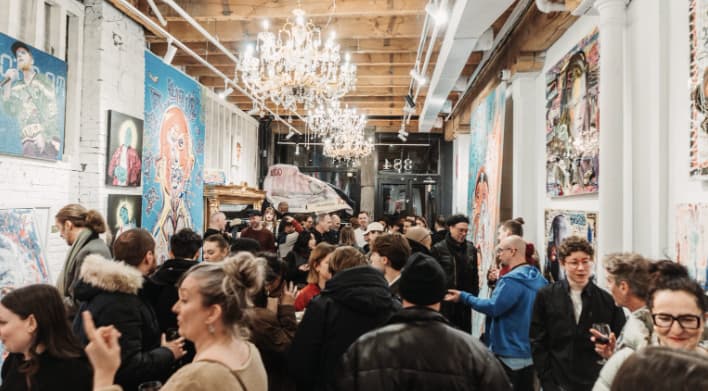
Visual arts · February 2, 2023
Artistes de rue montréalais : hommage aux pionniers
« L'Original pays tribute to the pioneers of Montréal urban art with a double exhibition spanning thirty years of landmark works. »
Éric Clément

In plain terms
How you find a piece, how you commission one, and how an artist works with us. Step by step, no jargon.
Side 1
Find a piece, share it, commission one, receive it.
Two routes, one catalogue. You pick the door.
Every piece is described against the same criteria: colour, density, gesture, material.
The quiz has you choose, one card at a time. Search by image reads a visual you drop in. That is the only difference between them.
The quiz reaches the taste point through a sixteen-step trajectory, search by image projects a dropped visual straight onto it. Both converge on the same area of the catalogue.
Sixteen cards, about 90 seconds, and you have your three pieces.
You swipe pieces left or right. Each choice sharpens your taste.
After four cards the result is still vague. After sixteen it is clear. Try it below.
Try it
A deck of cards to swipe feeds sixteen gauges. After four swipes the gauges are low and uneven; after sixteen they form a clear, contrasted taste profile.
Drop in an image, we show you the pieces that answer it.
A canvas, a photo, a tattoo, the colour of a wall: an image says almost everything about your taste.
It says nothing about your budget, the size, or the room it is going in. Those are the only questions we ask, and they are optional.
Try it
A canvas, a colour, a photo, a tattoo.
An identity you love.
An uploaded visual is analysed against sixteen criteria, then matched with four catalogue artworks in decreasing order of affinity. If none fits, a custom artwork is proposed.
Private · JPG, PNG, HEIC
16 swipes, about 90 seconds
A dropped image feeds sixteen gauges at once. Thirteen fill straight from the visual; three stay empty because an image carries no budget, no size and no intended use.
A piece made for your wall, and a contract for both sides.
You describe what you want, then you talk to the artist and someone from the gallery on the same call. The questions get settled there, not three weeks later.
You leave with a contract, read and signed by a gallerist, sent to you and to the artist.
During a call between the buyer and the artist, the missing questions are asked live, two project sheets are produced, then a contract is sent to both parties.
Money moves in stages, and nothing ships without proof.
On a custom commission, payment happens in two parts. Before anything ships, you get photos of the packed crate and the tracking number.
If there is a disagreement, a gallerist settles it against the contract, the same one for you and for the artist.
A timeline from signed brief to shipping, with two fifty per cent instalments, a gallerist who arbitrates, and photo proof of the packed crate alongside the tracking number before dispatch.
Side 2
Apply, get your work online, set your price, get paid.
You fill in a form. The rest happens in seven steps.
After the form comes selection, done by the team, then emails that keep you posted, then a call.
Then your images arrive. A person opens and approves them one by one. Room mockups and descriptions are produced from there, then reviewed.
Seven steps in two phases. Getting in touch: the form, the selection of applications, automated emails to the artist, then the call. Going live: receiving the media, generating room mockups, then generating descriptions.
A profile exists the day someone publishes it.
Creating a profile does not make it public: a member of the team has to publish it.
If an artist page looks empty online, it was not forgotten. It has not been published yet.
The artist sets the price. We take 38%, and nothing else.
The artist's price is never altered. Taxes and shipping are added on top and paid by the buyer: they do not reduce what the artist takes home.
The dashboard shows all three numbers side by side: what the buyer pays, what the artist receives, what appears on the site.
The artist packs the work. The gallery handles the rest.
When a piece sells, the gallery collects it from the artist and delivers it to the buyer.
The payout is handled by a person, from the pending payments list.
You keep selling elsewhere, and you owe us nothing for it.
An artist sells through their own shop, another gallery, or directly, at the same time as with us.
The commission only applies to the sales we make.
You upload once. The listing gets reworked to each platform's format.
One photo, one title, one description, one price. Every platform then demands its own fields, and that is the work few artists have time to redo six times over.
The idea is that the gallery takes it on: rework the listing to each destination's format, and keep it current.
A single source file, one photo, one title, one description and one price, goes through an optimization step that produces one format per channel. Six destinations come out: Artsy, Etsy, eBay, Google Merchant, Facebook Marketplace and PickArt for custom commissions.
Dues buy advertising, not a place in the catalogue.
Participation fees go back out entirely as advertising, split evenly between artists.
They do not change your rank in the quiz or in search by image.
In the press



Grounded in research
The model grew out of a master's thesis by our founder, Dorian Verdier (M.Sc., HEC Montréal, 2024), on the democratization of art among citizens in the digital age, carried out in the lab with UdeM and Tech3Lab.
Master's thesis
PDF · HEC Montréal, 2024
French version only
Visual arts · February 2, 2023
« L'Original pays tribute to the pioneers of Montréal urban art with a double exhibition spanning thirty years of landmark works. »
Éric Clément
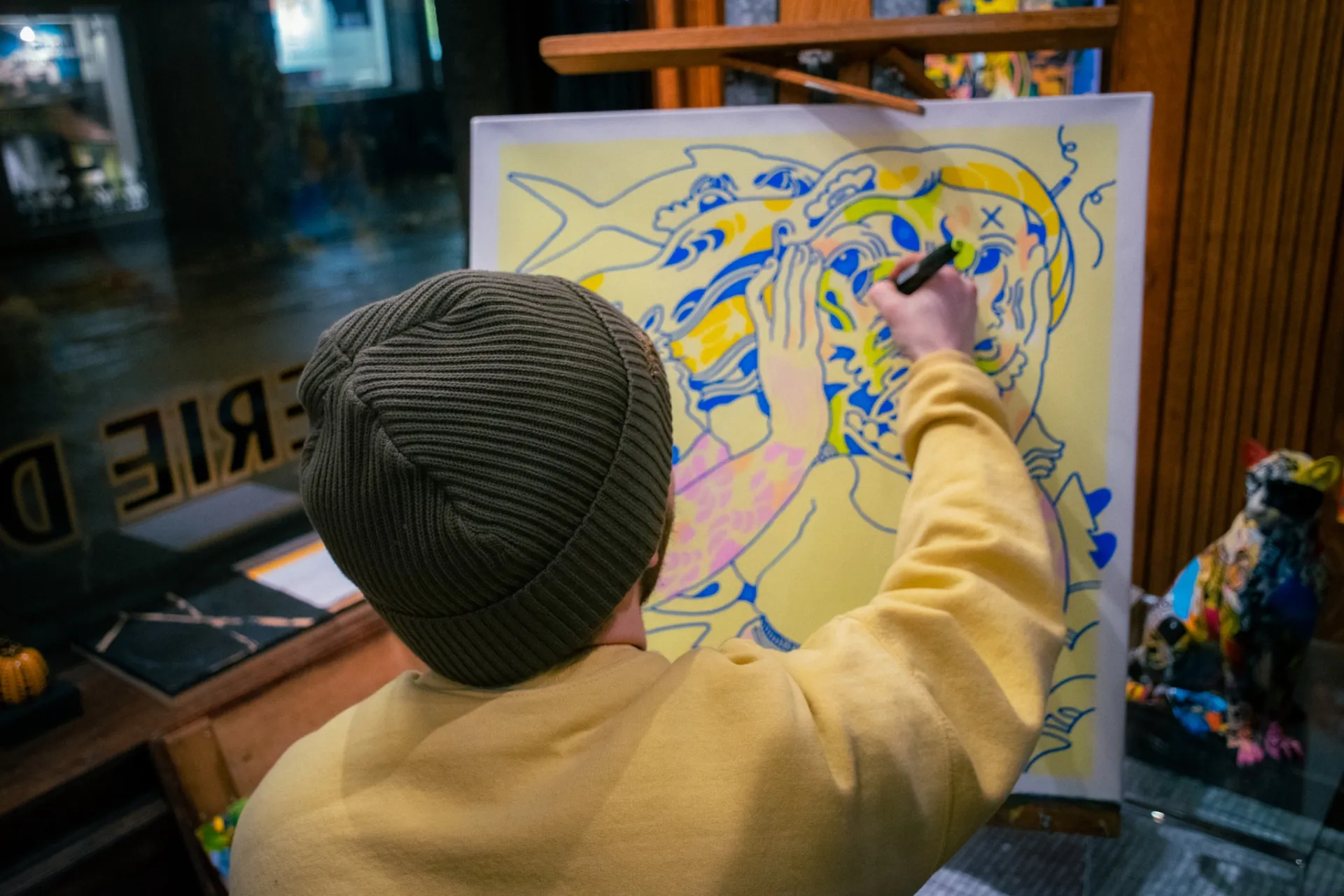
Society · April 2023
« Montréal is home to the highest concentration of artists in Canada. L'Original helps these urban talents shine locally and internationally. »
Alexandra Grenier
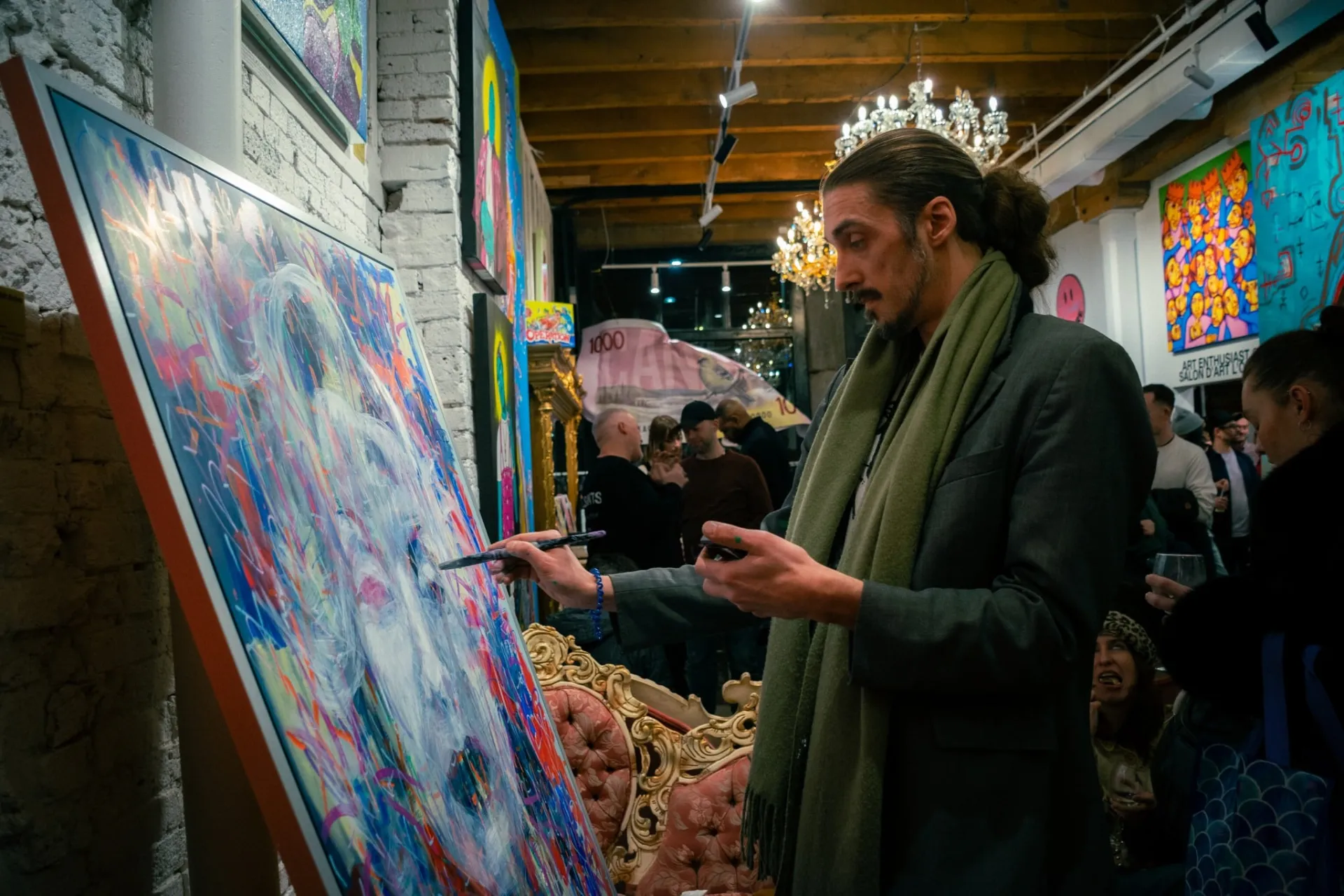
Culture · 2022
They built technology to support artists. A company was born, backed by a network of angel investors.
If something is still unclear, tell us. It is easier now than once the order is placed.


