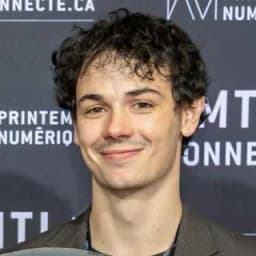
Marven Clerveau: painting the bodies a society would rather not look at
Published July 30, 2026
A self-taught painter, born in Montréal to a Haitian family, living with dysphasia and scoliosis since birth. Marven Clerveau turned two medical conditions into a subject, then into a body of work honoured by the Lieutenant Governor of Québec and funded by the Conseil des arts et des lettres du Québec.
This monograph follows that path, from workshops at a Montréal disability association to the walls of the Centre Phi, and examines what his newspaper collages actually do to the figures they cover.
Drawing as a first language
Marven Clerveau was born with dysphasia, a language disorder that makes speech and comprehension difficult, and with scoliosis. According to the portrait published by the Conseil des arts et des lettres du Québec, he underwent spinal surgery at the age of ten, then fell two years later, breaking the metal rod that had been implanted, which meant several more months in hospital.
Drawing began at school, encouraged by teachers who sent him to after-school workshops. He later took part in an artistic exploration workshop with the Association de Montréal pour la déficience intellectuelle and received mentorship through Diversité artistique Montréal. He remained self-taught, which in his case is not a gap in the résumé but the actual method: a language built for himself because the usual one was hard to use.
« I make visible what society prefers to hide. »
The Scoliose series and the broken column
One body of work takes his own spine as its subject. The Scoliose series answers a specific painting, Frida Kahlo's The Broken Column of 1944, in which the artist opened her own torso to show an architectural column cracked along its length. Kahlo made a private medical condition into a public image, and did it without asking for pity.
Clerveau takes up the same problem, sixty years later, in a city with a different relationship to disability. The question a viewer should ask in front of these works is not whether the artist is suffering, but why an atypical body remains so rare in painting at all. In an interview with the CALQ, he says he realised he does not define himself by those conditions alone, which is precisely why the series is a passage rather than a destination.
Newspaper under the paint
His technical signature is the integration of newspaper into acrylic painting, with pastel. The choice is not decorative. Newspaper is the material of public discourse, the surface on which a society writes down what it considers worth reporting, and it yellows, tears and dates faster than any other support. Building a face on top of it puts an individual over the record that usually forgets people like them.
The figurative register that results is legible without being naive: recognisable faces, a strong graphic structure inherited from the comics and manga he drew as a teenager, and a surface that keeps the texture of the printed page. That combination is what makes the work hold on a wall at domestic scale and at exhibition scale alike.
Recognition: the medal, the grant, the Centre Phi
In 2015 he received the Medal of the Lieutenant Governor of Québec, awarded for exemplary community involvement. In 2020 the Conseil des arts et des lettres du Québec granted him a Vivacité award, which allowed him to rent a studio in Hochelaga-Maisonneuve. In 2019 he published a graphic novel, Dragonlier: le monde intérieur, with Les Éditions Mots Roses. In 2021, during Black History Month, he exhibited Disphl'Égo at the Henri-Bourassa library.
The clearest public milestone came in 2022 at the Centre Phi, with some twenty large-format portraits of figures from Québec hip-hop, presented as Visions Hip-Hop QC. Painting a rap scene as a gallery of portraits is a historiographical act: it says that this culture deserves the same treatment as any other subject a museum would hang.
Collecting Marven Clerveau
Few artists at this price level carry a comparable record: a provincial distinction, a public arts council grant, an institutional exhibition and a published book. For a collector, that combination reduces the usual uncertainty, since the work has already been examined by juries that had no commercial interest in it.
For organisations, his work speaks directly to an audience that rarely sees itself represented, which makes it a considered choice for a hospital, a school, a community centre or an office that talks about inclusion and would rather show it than say it. He also takes mural commissions.